Piano lessons in Bath

Author: bathpianolessons (Page 3 of 3)

Book Recommendations for Early Learners of the Piano

There are many books available for young piano students of 5 – 8 years of age; it is a lucrative and highly competitive market, and choosing the right book for your child can be a minefield. It is also a difficult age range to write for, as a child grows and develops at an amazing rate, coming out of the pre school environment into one where they are being thrown numerous new concepts and skills to learn.

No two children are the same, one may respond well to one book while another may hate it. There will be trial and error in the process. I would like to share a couple of titles that I have found to be effective and yet fun for the learner. I have found these books work well primarily because the design is uncluttered and inviting, with advancing steps in technique and theory made at a steady pace. These books proved themselves through the trial and error process, so hopefully it will give you a head start.

One of my guiding principals has always been ‘can I understand the book easily’. You do not have to know anything about music to notice when a book has cluttered design and layout, or jumps from reading notes to sharps and flats within the first two pages.

Most children need to grasp the initial concept of associating a dot/line on the page with a key on the piano, and this is seldom easy. When that is comfortable, you then need to introduce how the appearance of the note also indicates a rhythm (crotchet, minim etc). When finally bringing two hands together to play, you have introduced three distinct skills that need to be performed simultaneously, before you can even consider musicality. That is already a lot of concepts to introduce to a young learner. Children are like sponges and do have an amazing capacity to take on many concepts, but this nearly always has to be done in a logical way that makes sense. So if you are struggling to understand the book, chances are your child will struggle too.

You can find the titles easily by searching on Amazon or Google. They are in no way a definitive guide, merely my current favourites that I have been using for the last few months. If you are unsure, you can go into your local music shop and compare them with other books, perhaps finding an alternative title that could work better for your child/student.

Me and My Piano, Fanny Waterman & Marion Harewood 

This is a great series because the book pages are colourful and uncluttered. The order of introducing a new note on the piano and gradually introducing the left hand is logical and there are no big jumps in theory concepts between sections. There is a gradual increment in difficulty level that is easy to adopt.

The Harewood & Waterman series also provides a series of test papers called ‘Monkey Puzzles’. These are a fun way of tackling pure musical theory, never the highlight of any piano lesson. However the ‘puzzles’ always relate the theory back to the keyboard and feature a points system to encourage concentration. The final paper of snakes and ladders through music theory has proved very popular with my students!

Poco Piano for Young Children, Ying Ying Ng & Margaret O’Sullivan Farrell

This was a revelation for me, as I was searching for a book that was super simplified in layout and technical progression. Many books for this age range tend to drop the learner straight into the deep end with key signatures and two octaves by page five. This book is  greatly staggered, simply working with a new note per page. The corresponding space or line on the stave is also colour coded, helping to highlight the new element being learned.

The design is clean and fresh, with imagery that is inviting while seamlessly incorporating the music stave into the overall picture.

It also has stickers. It will come as no surprise to most parents that young children respond well to stickers, as they are a form of reward. Here the stickers actually correspond to the answer of a question being asked, for example, a question on the treble clef would have a sticker showing the symbol for that clef. I have yet to come across a young learner who does not take to a small reward like this, and indeed learning should have a constant element of reward to create a sense of achievement.

Final Thought

I hope this helps, at least in getting started. Do not be surprised if you try one book and later end up buying another one from a different author. This is all part of the learning curve for student, teacher and parent.

Student Recital at The Piano Shop Bath

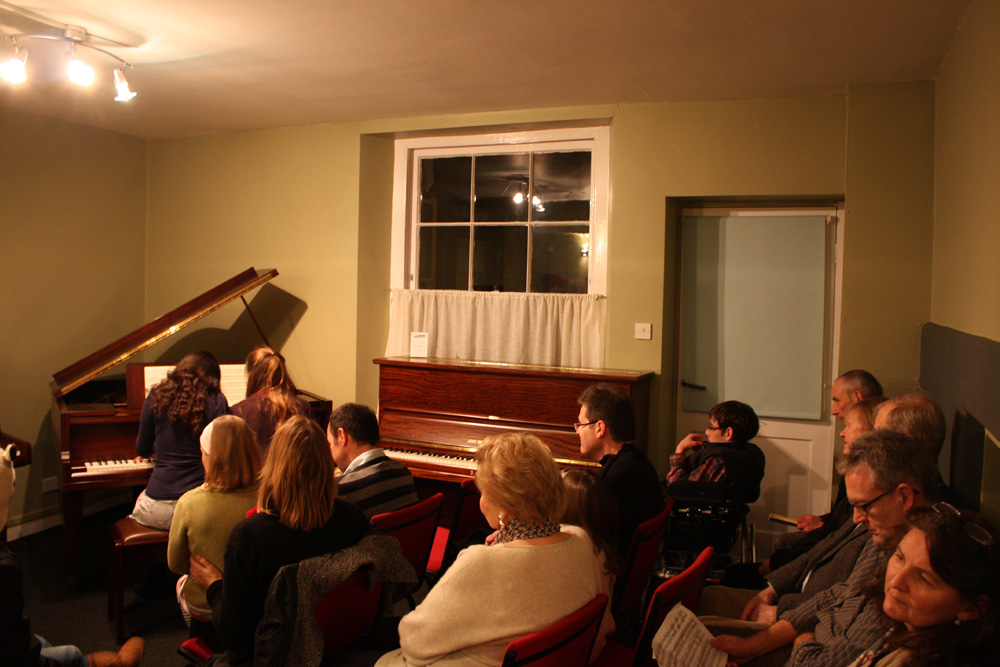
I recently teamed up with fellow piano teacher Susanna Downes to hold a piano recital for our students. Susanna and I talked about the possibility of combining our students for recitals, as it provides a greater opportunity for interaction and helps to boost numbers at times of the year when not everyone can participate. Our main issue was finding a reasonably priced venue and piano for hire, taking into consideration that it would be a small number of students.

I work weekend shifts at The Piano Shop Bath, and I had been trying to see if there was a way we could hold some kind of interactive event at the showroom. The basement of the shop had recently be opened and refurbished into a showroom, and I started to think of it as a possible venue for the recital. It has the advantage of being well located on the London Road into Bath and of course, having a piano for performance is no issue! My manager Jon was on board from the start and provided full support with tuning, moving pianos to make space, and canapés! I should also give a very notable mention to Father Peter Edwards from nearby St John’s Church, who allowed us to borrow some chairs for the recital.

Once the chairs were set up we knew that the basement showroom would have the right kind of intimate yet supportive atmosphere needed for the students. As some of my younger students arrived I could see there were a few nerves, but having family there for support undoubtedly gave them the courage they needed to play their pieces. We had eight students in all between us, playing a range of pieces from beginner to intermediate levels. All of the students made parents and teachers proud, excelling in understandably nerve racking conditions, and putting in some really musical performances. At the end all the students were presented with a certificate for their excellent efforts.

Student Recital 30/11/2013

Student Recital 30/11/2013

The evening was a thorough success. Susanna and I look forward to continuing the collaboration with The Piano Shop Bath, providing more regular opportunities for students to perform their music. Student recitals tend to fall at the end of the Summer school term, being a natural point in the academic year to have a concert. Many students will also have recently taken their music exam around this time. And yet for the rest of the year, performance opportunities are few in number.

The logistics of setting up an environment where students can play to a willing audience, are more difficult than one initially assumes. Simply finding a reasonable-sized space with a decent piano can be challenging, and then organising the various friends and family to turn up can be a huge task in itself! So the opportunity The Piano Shop Bath provides for Susanna and me is of immeasurable help. Performance skills can seldom be taught; you have to gain experience and learn to work with the natural reactions your body and mind go through. Ironically there is little guidance from exam boards on how to approach a musical performance, yet an exam will allocate nearly two thirds of the marks precisely on performance. The best way is through regular performances, with support from teacher, family and friends.

If you know you have an exam coming up it is highly advisable to have at least two or three practice runs with an audience. Even if you make mistakes, you will be preparing your mind and body for how to deal with them and keep going unaffected. You will also get better at acclimatizing yourself for being under observation. Remember, there are very few audiences that will be looking for mistakes, they are always willing you to play at your best. So relax (as much as possible!) and give yourself to the instrument and the music: the rest will fall in to place.

Click here for a link to The Piano Shop Bath

Leonardo Da Vinci’s dream instrument built and heard for first time in 500 years

This is not really a teaching related post, but it is very much keyboard related!

A good friend sent me this fascinating article and video of an instrument designed by Leonardo Da Vinci. Turns out that it has taken 500 years for someone to get round to actually building it, and it sounds absolutely mesmerising.

I won’t say anymore other than to link you both to the video and the original article:

For the article click here.


Thoughts On Passing My ATCL Diploma

Aside from giving piano lessons in Bath, my advanced study of music continues. Some of you might notice that I have recently added the letters ATCL after my name.  This is the first tier of professional qualification that you can attain after grade 8. There are three levels: ATCL, LTCL and FTCL. The ATCL is described by the Trinity exam board as being equivalent to the first year at conservatoire. For comparison the next level, LTCL, is equivalent to the final year at conservatoire.

The ATCL exam consists of a half hour recital of music chosen by yourself. What made the Trinity exam board attractive was the possibility to submit one’s own choice, as well as picking pieces off the syllabus. As a lover of jazz and in particular of Oscar Peterson, I wanted to juxtapose his music alongside my other choices of Beethoven and Chopin. Here is the programme I performed:

Ludwig van Beethoven

Piano Sonata No. 8 in C minor, Op. 13 ‘Pathetique’ 19:47

Oscar Peterson

Two selections from Peterson’s ‘Canadiana Suite’

Ballad to the East 4:41

Place St Henri 2:10

Fryderyk Chopin

Nocturne in C minor, Opus 48, No. 1 6:49

Total programme time: 33:45

You also have to produce short programme notes, the majority of which I won’t bore you with here. However, one point I would like to share was my linking of these three men, who were separated by a century and a half. They were all piano teachers at some point in their lives, and they were all brilliant improvisors. This grounding in exploration through improvisation inevitably affected the music they wrote, as they pushed themselves to write music that would utilise the piano to its full potential.

So: you get on with learning, hold your breath as you submit your entry and practise like mad. For people considering taking the ATCL, I should perhaps elaborate on the last point. I had to schedule my practise to ensure I was doing enough hours per day. Teaching and other part time work eats in to my available practise time, and you have  to make time for friends or loved ones as well. I took to heart the lesson from close associates of Maria Callas, who claimed she died of a broken heart and loneliness rather than the medical cause. You can be fantastic with your instrument, but it is nought without loved ones.

Dreary point over. So I got the practise time in. For me, the point of practising a piece is to free yourself for interpretation. I knew I had to know the pieces inside out, backwards, sideways and blindfolded if possible, so that in the exam room I could concentrate on interpretation. I have always left two months before an exam to work just on interpretation and musicality. Why? Because music exam boards do not give high marks for pressing all the notes at the right time. That is assumed from the moment you enter your chosen pieces. You are there to perform something to the best of your abilities with your interpretation. For instance, the Beethoven Pathetique Sonata has probably been played hundreds of thousands of times since the ink dried on Ludwig’s manuscript. Who cares if you can play it? I can listen to a CD of Barenboim playing it to perfection. I can also pay money to see a concert pianist perform it well. British pianist Stephen Hough said that once you have learned a piece, that is when the real work starts.

So when you make that commitment, especially to music that is well known, you have a duty to give yourself to the music and prove to the audience why, in that moment, you are creating for them something unique. You are giving them a piece of your soul. I understand that’s very esoteric, but in my experience that is what it boils down to. Audiences and especially examiners can tell when you are going through the motions, and will not forgive you for simply getting through the piece.

The Andy Murray Effect

The run up to my exam also coincided with Andy Murray’s historic victory at Wimbledon. I have followed Andy for some years and it was obviously a moving moment to see him achieve what I always knew he could do. As has been widely commented, Andy’s struggle to win majors was never the technical part of his game but the mental part. The joining of Andy with coach Ivan Lendl’s mantra was crucial: you know your game, you have spent thousands of hours over your lifetime practising repeated shots and movements. All that is left is to play every point to the last, never relenting until you have won this last point. Roger, Rafa, Novak and now Andy all have this deep level of concentration that is grounded in their knowledge that the hard work has been done, leaving just the playing and winning.

This preparation is exactly the same for playing the piano and I took it wholeheartedly on board in the run up to my exam. As a pianist you spend hours practising patterns of notes over and over, perfecting them and injecting your musicality on them. The mental side of piano playing is never given as much weight in piano teaching as the technical side, but come performance time it has equal weighting. The knowledge that you have done everything possible to prepare lifts a huge weight off your mind. Nerves are something I still work with; they are a natural reaction your body has, but it is how you deal with those nerves that helps you perform at your best. When I walked into the exam room I was already converting my nerves into adrenaline, I believe because I knew in my mind I was ready. There are no surprises, you know what pieces you are going to play. If you have done the work and know every note on the score, what is there to be afraid of? Yes, you might make a technical slip, but so long as you can do it from start to finish with your musicality and drive shining through, people will only remember the end result. Think of technical slips as a tennis ball just clipping the net as it bounces in to gift you the break point. You keep moving to towards something great. As Ivan said, ‘All you can do is keep putting yourself into that position and give it all you have.’

One other thing I had from doing all the work is confidence. Confidence in performing takes away that fear that might have occurred just before a difficult set of running octaves. So what if the next bit is difficult? You know how to do it and you should show that you can play it as well as the hundreds of times you’ve done in private study. Confidence puts an audience at ease and more importantly it puts you at ease. The one word that was repeated several times in the examiner’s report for my exam was confidence.

And finally concentration. Concentration had to be absolute throughout the recital. You have to be at one with what you are doing. There are many unknown pianists out there struggling to be heard, playing the same pieces as Lang Lang. The difference is that Lang Lang has an extreme level of concentration. He is not technically more gifted than other pianists, but he is certainly one of the top pianists today for extreme concentration under pressure. In fact, I would guess that his concentration is so natural that he no longer feels pressure.

When I played the final piece by Chopin, my concentration was at its highest. There was no music in front of me and it just happened to be my favourite piece of piano music. I couldn’t tell you exactly what happened as I was so involved, parts are a blur in my memory. But I remember having my eyes closed for some of it and when I played the final note I knew I had played well. I knew I had given myself and left it all in the exam room. And although I can’t say for sure, when I took my bow I could see that the examiner knew this too.

Final Thoughts

The danger of over practise. This was becoming apparent in the final two weeks before the exam. So I took days off from playing, and when I did practise it was just going slowly over certain difficult parts. You have to remember that in the final week before an exam there is very little you can do to improve on the work you have done.

After I did the exam friends immediately asked, ‘what will you do now?’ This was a very humbling moment as after the high of your result, you realise that in many ways it is just a piece of paper. Of course, it forms part of my professional development and is good to have when you are a teacher. But being asked this put me back on the spot of reassessing goals.

Obviously the next level of LTCL diploma is on the cards. But I am a composer as well, and in the run up to the exam I had to put this to one side in order to focus on my preparation. Now I am back with the manuscript and paper, working on a couple of projects that might be performed later in the year. I will be building a site just for my composing portfolio, so in the next blog or so I will be updating you on this. And I have booked myself in to do a lunchtime recital at Manvers Street Baptist Church in the Autumn, hopefully this time to a real audience and not a solitary examiner. I did some practise recitals to random audiences in the run up to the exam and afterwards I would chat with them. In doing this you reaffirm the notion that not everyone can play that level of music, and many people who cannot play an instrument derive a lot of pleasure simply from seeing and hearing music in action. So my post exam action point is get out there and play!
Bath Piano Lessons – First Blog

This is the beginning of hopefully a regular blog on my piano lessons in Bath, UK.

Teaching piano offers a unique insight into people’s development as pianists. In my own piano studies, it is easy to get lost in endless self analysis and criticism. Hours of finessing legato lines and running octaves can narrow one’s outlook on learning, so teaching is a really good way to learn more about the instrument and the difficulties people can encounter with it.

I have a range of students from the youngest at 5 years of age to mature adult beginners. Each one presents challenges, as no two students are the same. We are all individuals, learning at different rates and responding to different teaching methods.

The two keys to teaching I have discovered so far are patience and empathy. Empathy is probably the most important skill of all. If I have a student who is losing concentration, I need to immediately ask myself ‘if I were in their shoes, why would I be losing concentration?’ This is especially pertinent for young beginners and I have found that this lovely summer weather can be a major distraction! So mixing up the lesson plan, trying new exercises and even just taking a 30 second breather can really help to find that focus for the last ten minutes of a lesson.

That’s it for now, but I hope to keep a more regular posting of teaching observations, my own studies and music life in Bath in general!

If you are looking for piano lessons in Bath or near by, then please do get in touch via my contact form!

Newer posts »

© 2026 Bath Piano Lessons

Theme by Anders NorenUp ↑